If you are searching for “TCA peel before and after,” you likely want to see what changes after treatment.
You may also want to know how predictable those results are.
A TCA peel is not an instant transformation. It works in phases, starting with a controlled skin injury, then peeling, and finally, gradual regeneration through collagen remodeling. The visible improvement usually becomes clear only after the skin has fully healed.
This guide explains what happens before and after a TCA peel in a clear, medically informed way. It helps you know what to expect at each stage.
What TCA Peel Before and After Really Means?
A TCA peel uses trichloroacetic acid to remove damaged outer layers of skin in a controlled manner. This process signals the skin to regenerate and rebuild itself with a smoother and more even surface.
Before treatment, most people have concerns such as uneven tone, pigmentation, acne marks, fine lines, or sun damage. These are surface-level and structural changes in the skin that accumulate over time.
After healing, the skin gradually appears more refined. Texture becomes smoother, pigmentation reduces, and overall clarity improves. However, the most important point is that these changes do not happen immediately. The visible transformation usually develops between week two and week six as collagen remodeling progresses beneath the surface.
Real TCA Peel Before and After Results by Skin Concern
The outcome of a TCA peel depends heavily on the skin concern being treated. It is not a one-size-fits-all result, and understanding this helps set realistic expectations.
Pigmentation and dark spots
Before treatment, pigmentation appears as uneven patches caused by sun exposure, inflammation, or hormonal changes.
After a properly performed peel, pigmentation often lightens significantly over time. In many cases, you may see improvement within a few weeks. Deeper pigmentation may need more than one session. This helps achieve stable results.
Acne scars and skin texture
Acne scars typically present as uneven texture or small depressions in the skin.
Following a TCA peel, the improvement is gradual. The skin becomes smoother as damaged layers are replaced and collagen activity increases. Shallow scars tend to respond more quickly, while deeper scars require multiple treatments spaced several weeks apart.
Fine lines and early aging
Fine lines are most commonly seen around expressive areas such as the forehead and eyes.
After treatment, the skin often looks tighter and more refreshed. This is not just due to surface peeling but also to bigger structural changes in collagen over time. The most noticeable improvements usually appear several weeks after the peel rather than immediately after healing.
Pores and overall texture
Enlarged pores are often linked to oil buildup and loss of skin firmness.
After a TCA peel, pores may appear smaller because the surrounding skin becomes smoother and more refined. This is a gradual visual effect rather than a direct physical shrinking of pores.
35% TCA Peel Before and After Results
A 35% TCA peel is a stronger, medium-to-deep peel. It gives more visible results but needs more recovery time.
Before treatment, people usually use it for more advanced issues like deeper pigmentation, visible sun damage, or acne scarring.
After healing, the results are usually more pronounced compared to lighter peels. Skin tone becomes more even, texture improves, and pigmentation reduction is more noticeable. However, the trade-off is a longer and more intense peeling phase that can last up to two weeks, depending on the individual response.
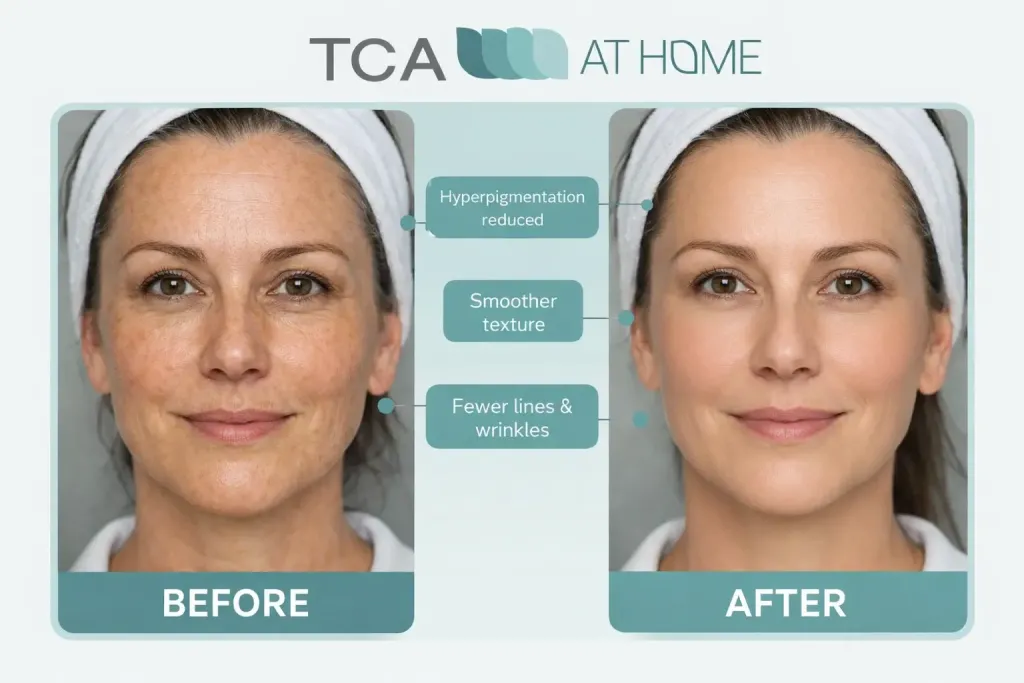
TCA Peel at Home Before and After Results
At-home TCA peels usually use lower strengths than clinic treatments, so results tend to appear more slowly.
Before treatment, the skin may show mild to moderate concerns such as dullness, early pigmentation, or uneven texture.
After treatment, improvements are typically subtle at first and build over time. Most users see brighter skin and a smoother texture within a few weeks. This happens when the peel is used correctly with proper aftercare.
The final outcome depends on preparation, application technique, and aftercare. This makes consistency more important than strength at home.
Realistic Before and After Timeline Day by Day
Start your preparation one week before the peel. You should stop retinoids, exfoliants, and vitamin C five to seven days prior. Use only a gentle cleanser and moisturizer. Also, perform a patch test behind your ear or along your jawline using the same TCA concentration you plan to apply.
Before the Peel (Day –7 to Day –1)
- Stop retinoids, exfoliants, and vitamin C 5‑7 days prior.
- Use gentle cleansers and moisturizers only.
- Do a patch test (behind the ear or on the jawline) with the same TCA concentration.
For readers who want prep details, link this section naturally to How to Prepare Your Skin for a TCA Peel. That article and the protocol page both cover avoiding retinoids, acids, vitamin C, and sun exposure before treatment
Day 0 (Peel Day)
On the day of the peel, a clinician or you yourself will cleanse and degrease your skin. After applying TCA, you feel a stinging sensation, and frosting (white patches) appear within 1 to 3 minutes for medium depths. Your skin feels tight and looks red, similar to a mild sunburn.
Day 1–2 (Pre‑peel)
During days one and two, the redness deepens, and your skin feels sandpaper‑rough. You see no visible peeling yet, so resist the urge to pick.
Day 3–4 (Active Peeling Begins)
By days three and four, active peeling begins. Light flaking starts around your mouth and nose. By day four, sheets of skin slough off in thin layers. Let the skin fall off naturally; do not pull it.
Day 5–6 (Peak Peel)
On days five and six, you reach peak peel. Your face looks like a peeling sunburn, but underneath that layer sits baby‑smooth, lighter skin.
Day 7–10 (Healing)
Between days seven and ten, healing accelerates. About 90% of the peeling stops, though mild pinkness remains. You can now wear mineral sunscreen and non‑comedogenic makeup.
Week 4–6 (Final Result)
Finally, in weeks four through six, collagen remodeling finishes. Your fine lines are reduced by roughly 30‑40%, and pigmentation lightens by 50‑70%. One peel delivers noticeable improvement, but a series of three creates dramatic change.
Real example (2025 case): A 42‑year‑old with forehead sun damage and enlarged cheek pores received one 20% TCA peel in 2025. Afterward, she saw 40% fewer visible lines, 60% lighter brown spots, and a pore size reduction of about 25%.
Why TCA Peel Before and After Photos Can Be Misleading?
Before and after images can be helpful, but they are often misunderstood.
Lighting differences, makeup use, filters, and timing all significantly affect how results appear. In many cases, “after” photos are taken too early in the healing process, before true results have fully developed.
A reliable comparison should always include a full timeline rather than isolated images from different conditions.
Risks and Realistic Expectations
A TCA peel is a controlled skin injury, which means it must be treated with care and respect.
It is normal to experience redness, peeling, dryness, and temporary sensitivity during recovery. In some cases, pigmentation may temporarily darken before improving.
More serious side effects are uncommon but can occur if the peel is misused or if aftercare is ignored. This includes prolonged redness, uneven healing, or, in rare cases, scarring.
- Pregnant or nursing people should avoid TCA peels.
- Avoid them if you have an active skin infection.
- Avoid them if you recently used isotretinoin.
Final Thoughts
A TCA peel before and after change is best seen as a step-by-step biological process. It is not an instant cosmetic change.
Initial peeling fades as healing begins. True results appear after the skin completes its natural regeneration cycle. Most improvements become visible within the first few weeks, while bigger changes continue to develop for up to six weeks.
The most reliable results come from correct preparation, appropriate strength selection, and disciplined aftercare. Without these factors, outcomes become unpredictable regardless of peel quality.
FAQ’S
Yes, you can achieve good results at home using low concentrations between 13% and 20% with strict aftercare. Higher strengths of 30% or more, however, require a professional. Home results typically reach 70‑80% of the effectiveness of in‑office peels, but at a much lower cost.
Those photos either come from superficial TCA peels under 15% concentration or were taken before the peeling phase began. Real medium peels always peel. Consequently, if you see a photo claiming “no downtime” and “dramatic results” from TCA, you should remain skeptical.
You must wait four to six weeks. Collagen takes time to remodel, so do not judge your success on day five when you are still peeling.
For lighter skin (Fitzpatrick types I‑III), use 20‑25% TCA. For darker skin (types IV‑V), a 13‑15% concentration combined with hydroquinone priming reduces the risk of post‑inflammatory hyperpigmentation.
Rarely, and only if you pick at scabs or use too high a concentration on active acne. For depressed scars, multiple light peels work better than one deep peel.